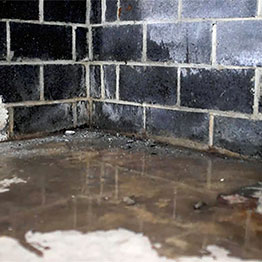
Elimination of conditions conducive to mold growth inside the wall cavity can very often be accomplished by simple application of materials required by the Model Energy Code, (MEC) and the International Residential Code, (IRC). The MEC requires sealing the building envelope to restrict air leakage, (caulking, sealing, and weather-stripping at all penetrations and joints). The IRC requires in section 602.8, Item 4, that the material used in annular spaces around wires and pipes be an approved fireblocking caulk. Use of fibrous materials, foams (including fire retardant foams), or noncombustible fill materials do not meet the requirements of these overlapping code requirements. An elastomeric caulk, fire rated in accordance with the testing protocol of ASTM E119 and/or ASTM E-814 does meet both requirements. The application of an elastomeric fire rated caulk at all penetrations between the ground level floor and the crawl space can prevent mold spores from penetrating into the stud cavity from ground level contributing to mold growth inside the cavity on wood and/or on drywall materials.
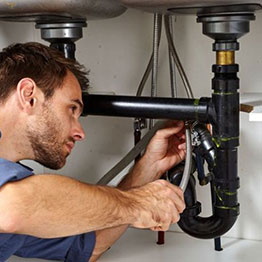
Existing homes can also be treated from the crawlspace or basement wherever pipes, wires, or other penetrants break the thermal barrier between the living area and the unheated crawlspace or basement. Application is much more difficult in existing structures because insulation materials are present and are an obstacle to accessibility to the annular spaces around the penetrants.
Recommendations to builders should include that instructions for proper fill of the annular spaces be strictly followed and steps should be taken beyond current Building Code requirements. These steps should include but not be limited to caulking with an approved, elastomeric sealing caulk rated to last 35 years or more, at every annular space wherever any wire, pipe, or other penetrating item passes through any wood, even where fire caulking is not required. Sealing each cavity from the adjacent cavity serves to prevent the lateral movement of mold spores and insures that any mold problem that occurs will be more isolated in scope and less costly to address.
In addition to proper sealing and fire caulking, a number of new products have been introduced to combat mold in new residential and commercial construction during recent years. One very promising approach involves utilization of biocide free coatings that are sprayed on the masonry walls of the crawlspace, on the floor joists in the crawlspace area, and on the floor deck below the first floor. These coatings are formulated to be so smooth that spores cannot stay on them long enough to germinate and even if the spore does germinate, it cannot utilize the organics in the wood as a food source. These coatings usually incorporate ingredients found in non-stick cookware to accomplish mold resistance. Some mold barrier sprays also utilize generally mild biocides such as Sodium Chloride, (table salt), or Copper Sulfate, (a swimming pool water treatment). A lower cost and equally promising product utilizes graphite as its base material, the graphite based products can score a perfect 10 when tested in accordance with the recognized mold resistance protocol of ASTM D-3273. Other non-stick formulations can also score at that level but current information indicates that in terms of cost to provide the protection, the newer graphite based formulations work at least as well as others and they do so at far lower cost of manufacture, which results in lower costs to the builder.
Some builders, especially those who have experienced mold issues in previous construction, are anxious for answers to their mold related concerns and have embraced a pro-active approach to building mold free homes. Building Inspectors serve the builder and the homebuyer well when enforcing building codes regulations during each construction phase that severely curtail or eliminate the possibility of mold growth.
Some of the elastomeric Fire Rated Caulks that comply with IRC code provisions and also meet current Energy Code requirements include:
| Product Trade Name | Manufacturer | Telephone |
| Elastomeric Fire Rated Caulks: |
| Metacaulk 66303 | Rectorseal | 713-263-8001 |
| FireLockRi | Protective Chemicals Corp. | 828-966-9213 |
| Firetemp™ CI Caulk | Johns Manville | 888-322-1129 |
| 3M™ Fire Barrier CP 25WB+ | 3M Corporation | 800-328-1687 |
| Mold Barrier Coatings: |
| E-Coat | EnviroCare® Corporation | 877-463-2628 |
| Steri Shield | Somay® | 305-633-6333 |
| Foster Products | H.B. Fuller | 800-231-9541 |
| Mold-Ban | Protective Coatings Corp. | 828-883-5865 |
| FiberLock®IAQ™ | Fiberlock Technologies, Inc. | 978-623-9987 |
Conclusion:
A mold free environment for many families can only be accomplished through good building code wording and enforcement. Responsible code enforcement personnel and responsible builders are the homeowners only line of defense against health problems resulting from molds, spores, and airborne toxins associated with mold in the home environment.
Recommendations:
1.) Vigorously enforce building code requirements relating to fire caulking at the plate between the "ground" floor and the basement and/or crawlspace area.
2.) Allow only flexible elastomeric fire caulking, tested in accordance with ASTM E-119 and/or ASTM E-814, (fire rated caulking is required in this application in accordance with the IRC, section 608, item 4), to be used as a fire barrier in the annular spaces around wires or pipes at the ground floor level, (elastomeric fillers create the tightest seal). Require "intumescent" fire caulk around plastic vent or drain pipes, (intumescent fillers grow with heat to close off the fire path when a penetrant melts from the heat). Many foam products, even those that are "fire-rated," release cyanide gas under fire conditions and melt at such low temperatures as to be ineffective under actual fire conditions. Fibrous materials allow for the passage of moisture, mold spores, and, under fire conditions, toxic gases. "Noncombustibles" tested in accordance with ASTM E-136 often shrink during cure and allow for the passage of spores and gases.
3.) Modify building codes by local amendment or at the code development level to include treatment with an approved mold barrier spray on crawl space or basement walls and on the floor deck below the first floor.
4.) Modify building codes by local amendment or at the code development level to require that the annular space around horizontal penetrants (penetrants not covered by fire-caulking requirements), be filled with an elastomeric caulking compound rated to last 35 years or more.
5.) Modify building codes by local amendment or on the code development level to require that framing and sheathing over "slab" construction be mold barrier treated to a height of 18" above grade.
6.) Continue to focus on construction of weather tight homes. Utilize house wrap wherever possible.
7.) Do not allow even miniscule leaks in roofing or wind blown rain leaks around windows or doors to go un-repaired even for a short period of time.
8.) Do not allow undersized returns, under any conditions, on warm air heating systems.
9.) Vigorously inspect site grading and drainage plans to be certain that rainwater is channeled away from the structure.
10.) Require a polyethylene vapor barrier below slab concrete, basement floor concrete, or on the exposed earth in the crawl space.
The above information is intentionally not copyrighted, permission is explicitly granted for the unrestrained use, copying, reprinting, or any other means of disseminating the information contained herein.
Information for this report was derived from a research project that sought to identify major challenges and corresponding solutions in one and two family residential construction, www.lmc.edu/firesurvey.
The chief researcher for the project, which was carried out during 2003 and 2004' was Richard A. Wolfe, PhD, director of Applied Sciences, (now retired), Lees McRae College, Banner Elk, North Carolina.
The study was funded by both private and public grants and subsidies.
Published 1/05/05
About this author:
Dr. Richard A. Wolfe recently retired.
He was the Director of the Applied Sciences Department of Lee McRae College, Banner Elk, North Carolina. Dr. Wolfe serves as an advisor to the US Department of Energy, Oak Ridge Technology Center.
This page is part of the Construction News & Articles section at GreatPossibilities.com.
All material on this website is copyright © of the author or original source unless specifically noted otherwise, and may not be used elsewhere without express permission from the author or original source.